Showing posts with label Simplicity. Show all posts

Friday, August 15, 2014

Historical Sew Fortnightly Challenge #15: The Great Outdoors (part Two)

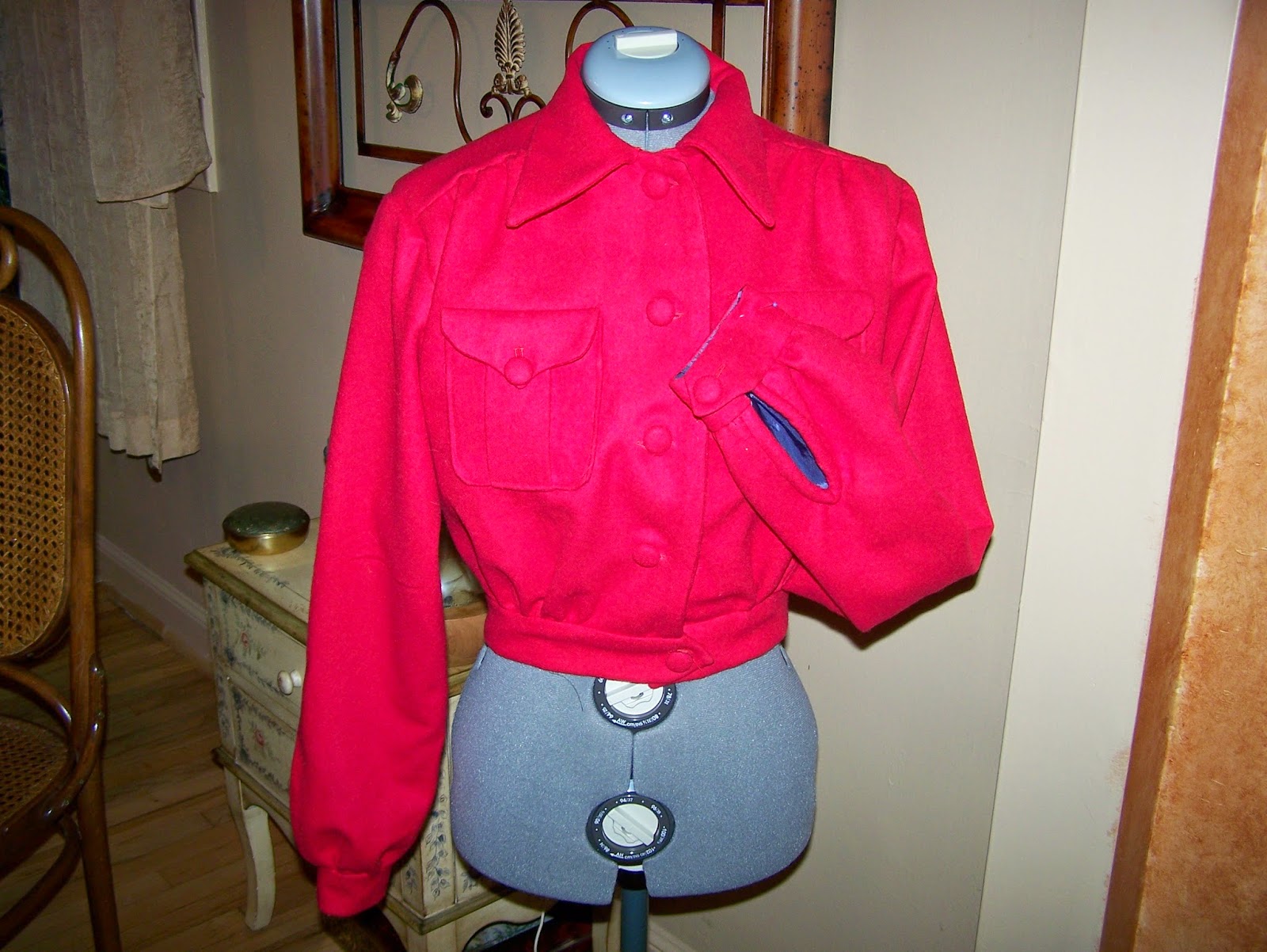
For my second entry for the Great Outdoors challenge I made a red wool version of Simplicity 4366.
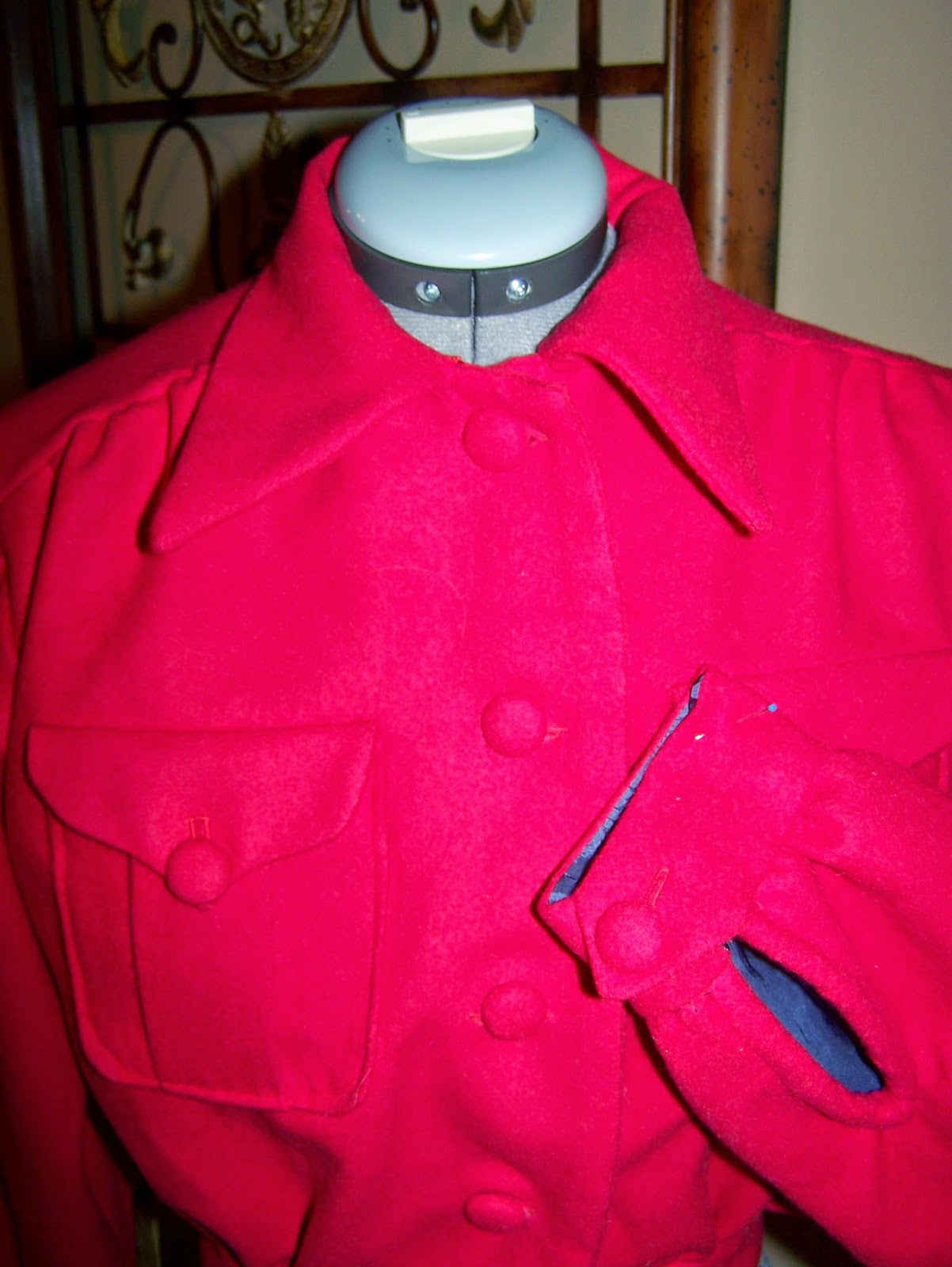
I love Ike jackets and I wanted one of my own for a while but then I found the red wool and decided that I would pay homage to the Ike jacket but make it my own. I have to give credit to Tasha from By Gum By Golly for starting the sewing bug for the jacket. Tahsa made a great 1940's jacket for Rochelle's Sew for Victory last year (2013) in a wonderful green fabric. From the moment I saw the jacket I knew I had to make one and here it is. The shoulders are gathered into a yoke and the waist of the jacket is gathered into a waistband. The sleeves are gathered at the wrist and finished with a cuff that buttons. The buttons are self covered and the red wool cooperated in waves that Murphy's buttons couldn't dream of doing.
The pattern called for self made shoulder pads but instead of stuffing them I used two layers of crinoline. The crinoline made the jackets shoulders keep their shape but don't make me look like a linebacker (which I appreciate). The Jacket is also fully lined; the pattern didn't call for it but I knew I wanted it lined because of the wool. I had to adjust the facing piece because of the change but that was a quick fix. For all of the buttonholes I used my grandmothers Singer 9134 which is cranky but works most of the time. I added the pockets to the front, they're from Colette Pattern's blog Coletterie and can be found here. For attaching the pockets I had to wing it since I don't have the original Colette pattern the pockets actually go to.

The Scoop:


Fabric: Red Tango Wool and Medieval Blue Lining
Pattern: Simplicity 4366
Year: 1942 (Thank you Anne)

Notions: 9 self covered buttons
First worn?: Only around the house, it's not cool enough outside to wear wool
Make again?: Yes but the peplum version in green corduroy with flannel lining

Total cost: Pattern $12 but I'll say $6 because there's a skirt pattern with the jacket, Wool Fabric $19.24, Lining $9.98, Self Covered Button Kit $5.99 so total $41.21

Tuesday, July 15, 2014

Murphy's Law Hat and a surprise HSF

I've made a cap and a headscarf but never a proper hat until now. The pattern was from the Vintage Pattern Lending Library a reproduction of Simplicity 1353 dated 1934. I made the caplet from this pattern for my first Historical Sew Fortnightly Challenge.  Incidentally Murphy also qualifies for the Historical Sew Fortnightly for Challenge #13: Under $10.
The fabric is a raspberry colored suiting from Joann's that I made my 1936 Suit from (that I haven't posted about yet. oops.)
The lining is also from that suit and is just a poly/cotton mix.
 This was my first time working with crinoline and also using self covered buttons. The Self covered buttons were good practice for what I actually bought the kit for, a Frankensteined Ike Jacket, because I found out a ball pein hammer works better than the little blue plastic setter the kit gives you.  But let's get back to the fact that this hat fought me the whole time I was making it. The fabric argued with me, the directions tricked me, I wasted at least 4 button backs, and I sewed every seam at least twice. Everything that could have gone wrong did go wrong.  One other fix I had to do was add a pipe cleaner to one of the seams because it kept wanting to collapse for some reason but I fixed that too. But I kept hacking away at it and now I have a very stylish hat named Murphy.


The Challenge: # 13 Under $10

Fabric: Raspberry Colored Suiting Fabric and Purple poly/cotton lining.

Pattern: Vintage Pattern Lending Library 1930 Ladies Hat, Gloves, Purse and Collar Ensemble a reproduction of Simplicity 1353

Year: 1934

Notions: 4 Self Covered buttons

Hours to complete: About a week of on/off sewing

First worn: Not yet. 

Total cost: Pattern $15 but since it has four items I'm saying the pattern for the hat cost $3.75, Crinoline was $2.99, Fabric scraps from stash, Self Covered Buttons free, and thread was also from my  stash. So Murphy cost $6.74

Monday, June 10, 2013

Simplicity 3673

So another WW2 Weekend at the Mid-Atlantic Air Museum has come and gone. This year it fell over M's Birthday so I treated him to tickets to the event.
I made Simplicity 3673 for the event. I bought a reproduction pattern cheap on Etsy and I don't think I'll buy from the seller again. The directions were not complete and some of the lines on the pattern that should have been traced with a straight edge were not so I had to take time to fix them. Beside that the pattern wasn't too difficult. The shorts were ok in size I just cut off 2" of the top so they wouldn't be soo high waisted. The top needed to be larger by one size (2") so I split the front pattern and back pattern in half and added a 1/2" to each. This worked wonderfully and I didn't even need to change the position of the darts. The shorts closed with 3 cute red buttons with anchors on them on each side, I did hand-worked button holes on the top button and machine sewed the other two. The top closed with an invisible zipper and I trimmed the collar in red. The sailor collar was the only thing that gave me any real trouble but between the mock up and the real thing I figured it out. I would add an inch to the bottom of the top when I make it up again because it was a little too short to stay tucked in during the even but it still looked cute when I had it untucked too. While at the event we got lots of compliments. M looked very handsome in his outfit. I was told I needed an overseas cap for my outfit so I will be buying Mrs. Depew's Flight Cap pattern in the near future to make one up. At a stand in the flee market a vender gifted me with a 1945 Christmas catalog from Filene's Department Store because no one else wanted it. I plan on trying to figure out how to scan my new catalog for all of you to see soon. I also walked away with two patterns this year. (M kept saying the tradition was one but the other was only $3.50 so I couldn't just leave it there) They are Hollywood 1898 Circa 1946 and Butterick 8315 Circa 1939. They will have to wait as I have lots of other projects to do before them but I am very happy to have them in my collection. I finally found a vintage hat that I liked and it was a steal at $15.

The Scoop:

Fabric: Sew Classic Bottomweight Stretch Sateen in Medieval Blue (I used the wrong side of the fabric as the right side so it didn't shine) 97% Cotton 3% Spandex

Pattern: Simplicity 3673
Year: 1941
Notions: 6  red buttons with Anchors at 3/4", red trim, bias binding for the seams and an invisible zipper
Hours: 4 days of off and on work including fixing the pattern and doing a full mock-up of the top
First worn?: June 8th 2013 for WWII Weekend
Wear again?: Yup! It's cute and comfortable. I can wear it as an everyday item and not just for WW2 events
Make again?: I think I'll make the shorts again and I might make the top again in a thin wool with long sleeves to wear in the winter. There is a matching skirt to the pattern and I might make that up one day too.
Total cost: $39.97 Even thought it was a little costly I paid with all of my supplies with a gift card except for $0.65.  Plus I still have one and a half spools of red trim left, fabric for another project, buttonhole thread and some bias binding.

Saturday, February 23, 2013

Dating Vintage Sewing Patterns

So I know this is a sticky topic because unless you've actually seen the year printed on the pattern you might not trust what others tell you. Well I completely understand that aspect because it drives me bonkers not being able to figure a year out but I have also noticed that any website I go to never gives an overly clear picture of multiple pattern companies. I've compiled information on Advance, Butterick, DuBarry,Hollywood, McCall and Simplicity patterns from the internet into one place so hopefully this helps someone trying to date a pattern. If you find something that is contrary to your knowledge please let me know so I can adjust this post to be more helpful. 

For all pattern a size 12 indicated a 30" bust until 1956 when a size 12 indicated a 32" bust and then in the 1960's sizes changed again and a size 12 changed to a 34" bust, this sizing continues today. Also from 1933 - 1935 a blue eagle emblem can be found on some patterns in support for the National Recovery Administration. NOTE: the number of the pattern is not always the best thing to look at because some companies reuse numbers or don't go in numeric order so look at the illustrations too. Since I'm a little OCD (CDO is what is should be) I will start with Advance patterns because it comes first alphabetically (but Butterick is the oldest tissue sewing pattern producer).
1934 or 1935

1938
Advance patterns did not print the copyright date on their patterns. During the early and middle 1930's the Eiffel Tower is part of the logo. In the late 1930's the word Pattern was added next to the name, and then between 1944 and 1945 the word pattern is written under Advance. In the late 1940's the type face was changed from a script font. From various Advance pattern booklets http://www.cemetarian.com  has gather these pattern numbers.


Advance 1933 Aug 896-1060
Advance 1941 Oct 2810-3540
Advance 1944 Jan 3419-3637
Advance 1946 Dec 4408-4423
1945
late 1940's (1947?)


Around 1939


Butterick also didn't print the copyright of their patterns anywhere on the pattern. In the 1930's to the early 1940's the Butterick logo was across the whole top of the pattern or in script print anywhere on the pattern. During the mid 1940's the logo was placed in a black box and in the late 1940's the logo was fixed in the left hand corner. In the 1950’s Butterick added a color box around logo and eventually this just became a light  gray.
1944
1951


DuBarry patterns were printed from 1931 to 1947 by Simplicity Pattern Company. These are difficult to date because some have B, D, or T after their Pattern number. In the early 1930's the logo was a black with white lettering and featured a woman with a wig and three feathers in her hair. During the mid 1930's the logo became a square box at the middle right hand side. Then in the late 1930's the DuBarry logo moved to the bottom left hand corner with the price of the pattern above it. With the 5000 series the logo moved to the upper left hand corner and was written in a script font. The 2000 series and the 5000 series overlap for the years 1941 and 1942. Around 1945 the logo changed to white font in a black strip http://www.cemetarian.com has compiled this list of pattern numbers.


1930's Lower than 2408 
1940 2408B-2561B 
1941 2562B-2666B and 5001-5126 
1942 2716B-2769  and 5273-5500 
1943 5501-5752 
1944 5753-5972 
1945 5973-6140
1946 6141-6212                                                                                                     


1931
Mid 1930's 
1939
1941 2000 series
1941 5000 series
1945

Hollywood patterns are known for the radio and movie stars that have graced the pattern envelopes (including stars Bette Davis, Lucille Ball and Betty Grable to name a few.) These patterns were in print from 1932 - 1947.Not all Hollywood patterns had glamorous radio and movie stars on their envelopes though. During WW2 Hollywood patterns had a star in the upper left hand corner. and they also had patterns from the 1930's with four stars below the logo on the left hand side. Some patterns lacked any of these other special markings. Originally it appears that the logo was along the top of the pattern envelope and then in 1935 the logo was along the left hand side of the envelope. This is where it stayed until the war when the star was used. After that the logo was written in script and kept in the upper left hand corner. http://www.cemetarian.com has compiled this list of pattern numbers.(They say 1932 - 1938 are estimates) I've found a pattern with the number 873 that is distinctly 1930's)
1932 1000-1099

1933 1100-1199 
1934 1200-1299
1935 1300-1399 
1936 1400-1499 
1937 1500-1599
1938 1600-1705 
1939 1706-1928 
1940 1929-1998 and 400-558 
1941 559-788 
1942 804-1021
1943 1022-1255
1944 1256-1489
1945 1490-1770 
1946 1770-1972 
1947 1972-2170

approx 1932
1940
1944


1946


McCall was the name of the pattern company until it changed it's name to McCall's in 1952. McCall did print their copyright dates on their patterns it's just a matter of finding them because Dates printed on envelope they were printed in various location.During the 1920's it seems the dates were anywhere on the envelope back, in the 1930's it was moved to the flap of the pattern and then 1940's and later it was moved to the back edge of the envelope. During the 1920's pattern envelopes were not the size they are today, with these patterns the McCall name was on the top. It then moved  to the right side of the pattern envelope during the 1930's. At this point the type used was a regular font which changed to script in early 1940's and then back to a regular font in the mid - late 1940's. Accessory patterns had a different  position of the logo along the right side still but in the middle not toward the top as the other patterns were.

1928

1934
1943

1947
1951
Simplicity printed their copyright dates on their instruction sheets with the exception of the early 1940's when they printed it on the front of the envelope. Their logo went through lots of changes through the years with the only exception being its location on the left side of the envelope. 1940 - 1941 Simplicity was in black font with Printed Pattern in yellow font with a black background. 1943 saw the introduction of the word Printed in red instead of yellow and the black background was dropped. Unprinted patterns cost .15 and printed ones cost .25. After 1944 all patterns cost .25 because there were no longer unprinted patterns and during  1951 the price increased to .35. There are also special designer patterns from simplicity that have larger pattern envelopes and cost twice as much as a regular Simplicity Patterns. Costumes during the 1930’s had their own sequence with numbers in the 7000 range and then there is the coveted S600 sequence of fabulous 1930's lingerie. http://www.cemetarian.com had compiled this list
1940               3264-3625
1941               3625-4046
1942               4043-4479
1943               4480-4845
1944               4865-4999 1000-1177
1945               1178-1195
1946               1490-1882
1947               1823-2274
1948               2275-2688
1949               2689-3043
1950               3057-3379
1951               3380-3758
1952               3759-4136
1953               4137-4520
1954               4521-4956 1000-1026
1955               4957-4999 1027-1408
1956               1409-1865
1957               1866-2330
1958               2331-2791
1959               2792-3296
1960               3299-3734
Simplicity S605
1938
1941
1942


1949
1951
I hope to add to this as is necessary and feel free to send me a message or comment if your research has turned up something different =] (PS I will get to Vogue but my eyes are starting to go cross eyed at the moment) I would also like to thank these websites for information on dating vintage sewing patterns 
http://www.cemetarian.com