Showing posts with label 1840's. Show all posts

Sunday, August 12, 2018

First Post Costume College 2018 Sewing Project

Post CoCo 18 I felt kinda down about my sewing skills. My ballgown didn't turn out as I was wanted and I kept seeing these amazing creations that I couldn't duplicate. But then I remembered something Kate said at CoCo and she said we were each just at a different point in our development. So it was kind of funny that I started this apron when I got home from a piece of fabric I got at the Bargain Basement. It helped to pep me back up even though it's such a small project. I did sew it completely by hand.

The pattern from the apron came from the Workwoman's Guide  Plate 11 Figure 14
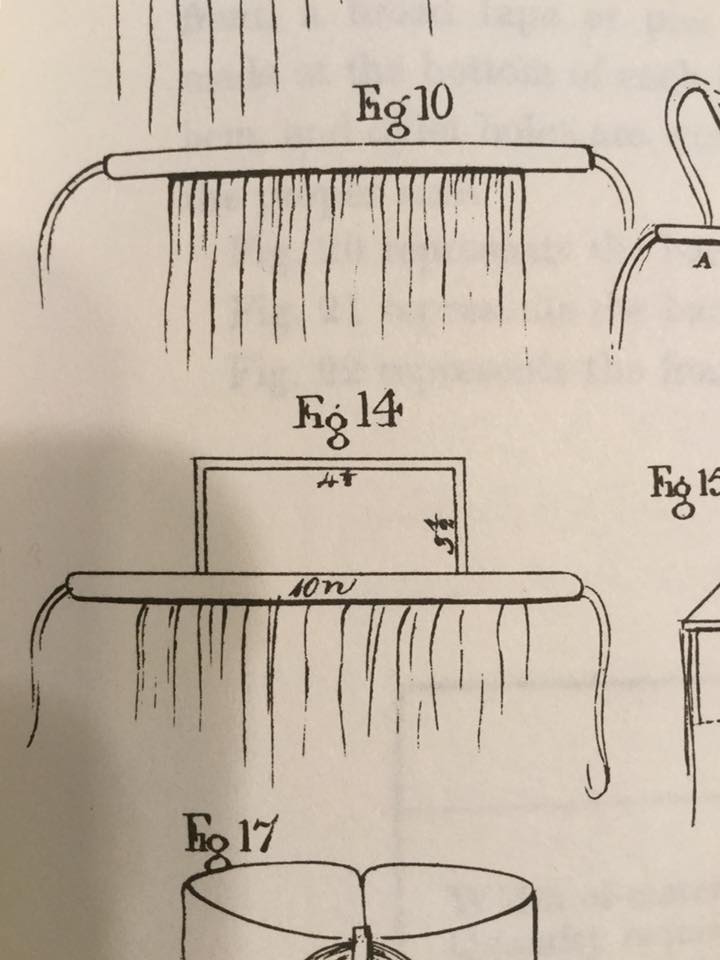

I used the bib measurements as they were because of the fabric I had left over from cutting the skirt and the waist band.  The ties of the apron ended up being as wide as the finished waistband which isn't how it's supposed to be but it works. The bib pins to the front of your dress so I'll be looking for HA pins in the near future. The leftover fabric will be used for a housewife or other small item. 


The Facts:The Challenge: Extant OriginalsWhat the item is: 1830’s / 1840’s Cooking Apron
Which extant original did you copy: Plate 11 Figure 14 of The Workwoman’s Guide by A Lady
Material: Checked Cotton
Pattern: Plate 11 Figure 14 of The Workwoman’s Guide by A Lady
Notions: Twill Tape Ties and Two Straight Pins
How historically accurate is it? I’d say 85%. I’m sure about my ties being the right size, or color and the Workwoman’s Guide assumes you know stuff we don’t now so the bib size may be out of proportion. Checked linen may also have been more appropriate than cotton but cotton is mentioned in other apron descriptions as being used.
Hours to complete: I think from thinking up the idea to completion is was about 4 hours. My hand sewing is slow.
First worn: Not yet. Have to finish an outfit to go with it.
Total cost: Free. The fabric was from the bargain basement at Costume College 18. The ties and thread were in the stash, so they cost something at some point but it is no longer remembered

Thursday, July 19, 2018

1840's Unmentionables

All I can say is thank goodness for the Workwoman's Guide. Granted the book has its quarks and it isn't always the easiest to follow but it is an amazing resource considering it has survived from the 1830's. The diagrams and corresponding measurements take some getting used to but once you get a basic grasp of them and make a mock up things move pretty easily. My plan was to make my shift, drawers, under petticoat, over petticoat, pocket and bustle all out of this guide.
I bailed on the shift and used Past Patterns #002 instead because I was unsure of the sizing. I may choose to give this a try at another point.  My drawers are cut but not finished, I'll update this post when they are. The under petticoat was made following the instructions for a flannel petticoat in the Guide. It is two yards of fabric gathered, with a wider waistband and buttons with a single button in the back, it does not have pocket slits and the hem is quite wide.

I've replaced this button with a wooden one I just don't have a new picture yet
The pocket is made following Plate 10 Figure 10. My only change was to construct the slit closer to an 18th Century pocket. It is large, but the perfect place for everything you could need. The front fabric is a printed cotton and the back is leftover navy linen from my 16th Century petticoat.


 The bustle (Plate 11, Figure 30, 32) was easy to measure, cut and sew, it just took time because I did all of the cording channels by hand. The Guide says to just add a thick cord but since I didn't have any bulky cording I did 5 channels of kitchen twine to each flounce so 10 in total. Twill tape is put through the channel that creates the two flounces and then I gather the bustle on the twill tape and tacked it in place so the bustle wouldn't loose fullness when I wore it. Pardon the wrinkles. I am thinking that starching it will give it a better structure under my skirts.


My first upper petticoat is pleated to a waistband with pocket slits and it ties at the side. I made it from an old embroidered sheet so it isn't too HA but it is pretty. I first wore it under my 1840's wrapper fro Costume College 2017.


Friday, June 15, 2018

A Tale of Two Shifts

The first tale is that of Past Patterns #002 Two Early Nineteenth Century Chemises. I made the open neck version with short sleeves. I made it with Kaufman Muslin and a combination of machine and hand sewing. I wore this for Costume College 2017 under my 1840's wrapper. I have two concerns with this shift, one is that the sleeves are a tiny bit constraining which isn't a huge deal when you're wearing a gown with dropped shoulders that are going to confine you anyway and the second is my fabric choice. While muslin (calico across the pond) is an era appropriate choice for the poor as the Workwoman's Guide says;

I just think that my muslin is too thick; which appears to be a common complaint about modern textiles versus historical textile. It appears to be better suited to petticoats (I've made one) and dress linings than a shift, however this article should stand up to many washings and  wearings. 


The second shift comes from 1830's Corset and Underwear Sewing Pattern from BlackSnailPatterns on Etsy. This is a different style entirely with a wide open neck and gathered sleeves. I made this one from 100% linen and it is completely hand stitched. This is the base for my 1840's ball gown for the Gala at Costume College 2018. My only complaint is that it doesn't have gores, though this doesn't impede my movement its just bothers me. It took me forever to hand stitch but I think it was good practice.


Thursday, September 1, 2016

Jane Eyre Dress

So here is my secret announcement..... I'm going to Costume College 2017! I'm super excited and have everything planned out in a little journal that is pasted with fabric and trim options, original inspirations, and pattern choices. I'll keep everyone updated as I go, but for now I'm working on my Jane Eyre costume. "I'll be married in this lilac gingham: you may make a dressing-gown for yourself out of the pearl-grey silk, and an infinite series of waistcoats out of the black satin." That is the only line in the book referencing her lilac gingham dress. Since there isn't anything else to go on I am starting with Truly Victorian's 1845 German Day Dress pattern. I might change it to look more like this dress from the Amsterdam Museum but I haven't decided yet. My fabric is 100% cotton Wide Width 1/16 in.Gingham Check Purple from Fabric.com. 


Obviously underclothing is in order as I've never sewn anything from this period before. I am taking my shift, drawers petticoats, bum pad and pocket from the Workwoman's Guide. My stays are coming from Corsets: Historical Patterns and Techniques by Jill Salen. I am using the Rural Corded Corset Pattern ( I was going to use the Corded Taffeta Corset Pattern but that one has bust and hip gores and as this is my first pair of stays ever! I am going to go with the simpler design.) Also can I just protest Salen's use of Corset for her stays dating from the 18th Century to the mid 19th Century? Anyway, moving on..... I bought a Brushed Twill in Tan for the outside of the stays, it is a little darker that I would have liked but I was thinking of these stays from the MET. (Not that I'm going to do the embroidery because those are skills I don't have, though a little something might be nice but I'm not planning on it.)


Back of  Woman's Corset (Stays) 
England, 1830-1840 LACMA

And the inner layer will be of left over Rockland 45" Cotton Duck Natural that I used to interline my Ravenclaw Renaissance bodice. I know linen in more period to line stays but it is also more expensive and using part of the Stash is a good thing. The one this I know I want to add is fan lacing. Fan lacing makes lacing ones stays or corset easier if you are alone. (If only I had some servants to dress me, but this would actually drive me insane so it's best that I don't have someone to do that.) The rest of the undergarments are going to be made out of  Muslin. Happily my insanity coincides with the Historical Sew Monthly's October Challenge: Heros. Since Jane Eyre is one of my literary heros I can hopefully use this outfit for the Challenge, Halloween and Costume College. Oh and before I forget to mention it, my shoes will be American' Duchess' Gettysburg Victorian Side-Lace Boots.
"Gettysburg" Victorian Side-Lace Boots (1830-1860s)I have the Gettysburgs and two other pairs of shoes for Costume College on layaway (Thank You Bastille Day Sale) so I might not have them for Halloween but that's not going to worry me at all. In addition I will need stockings, a day cap and a bonnet. I can pattern the day cap and bonnet from the Workwoman's Guide but I also have another bonnet diagram that I might use instead. I may also need cuffs and a collar or chemisette for the dress depending on which style I go with